Fuel Mod:
Zone by Zone.

What California fire agencies allow, and prohibit, at each distance from the house, plus the plants that most often get a fuel modification plan rejected.

The Landscape Is the First Line of Defense, or the First Line of Fuel.

California’s hills are beautiful, and they are built to burn. Native vegetation evolved with fire, summers are long and dry, and autumn winds can carry a spark a mile or more in minutes. Millions of homes now sit where houses meet wildland, and for those homes the landscape is not decoration.

Fuel modification is the practice of shaping that landscape on purpose. You change what grows, how much of it grows, how close it grows to the house, and how it is watered and maintained, so that an approaching fire drops in intensity and drifting embers find little to ignite. It cannot make a home fireproof, but it lowers the odds, gives firefighters a place to stand, and buys time.

Two layers of rules apply. State defensible space law (Public Resources Code 4291, enforced by CAL FIRE) divides the area around a structure into zones. Many cities and counties go further with a local Fuel Modification Plan, reviewed and approved by the local fire authority (for example LA County Fire, Orange County Fire Authority or San Diego County). Local names and distances differ, and the local fire authority always has the last word.
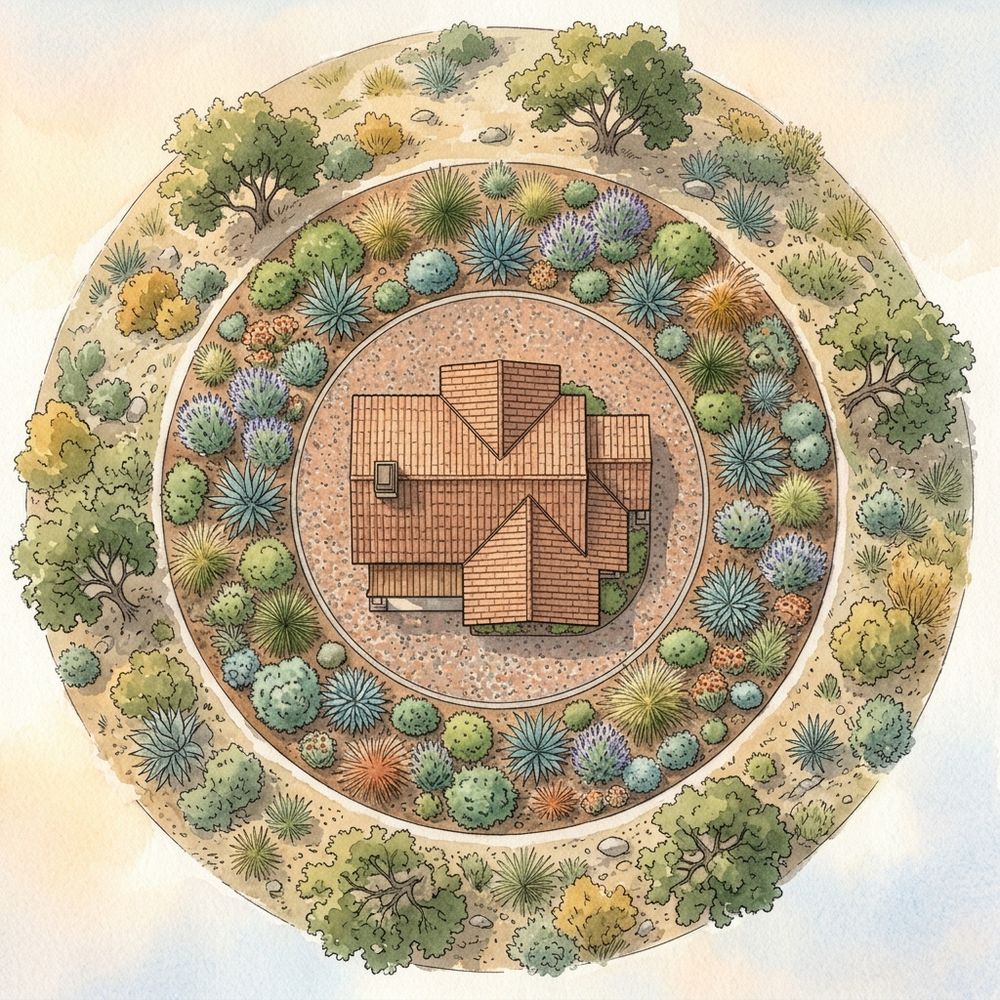
Watercolor aerial view of a house surrounded by three concentric rings: a gravel band, a ring of low spaced plants, and an outer band of thinned native trees
The idea in one picture: a hard band at the house, low spaced plants beyond it, and thinned native cover at a distance. Each ring lowers the fire’s intensity before it reaches the next.

Embers, Flames and Heat.

Embers

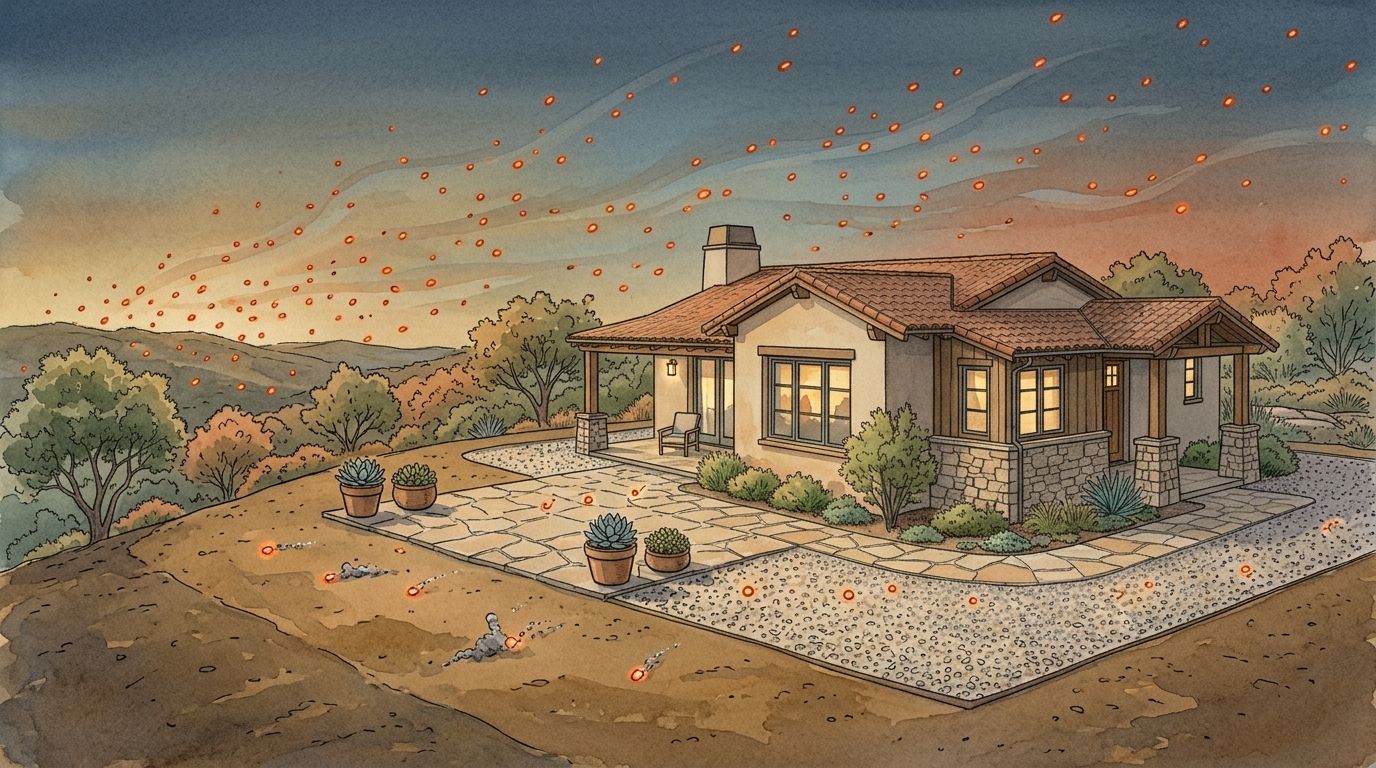
Burning fragments of bark, leaves and twigs travel a mile or more ahead of a fire. They land on roofs, in gutters, in vents and in the mulch beside the wall, and can smolder for hours before flaring up. Embers cause a large share of home losses.

Direct flame

Flames from burning shrubs, a woodpile or a fence touch the house, or come close enough to break a window and ignite what is inside.

Radiant heat

Large flames can crack glass and ignite siding or eaves without touching them. Distance is the main defense, which is why big, dense shrubs next to windows are a worse bet than the same plants thirty feet away.

Watercolor of a house at dusk with glowing embers drifting on the wind, landing on gravel and flagstone but finding nothing to ignite
Gravel and stone give a landing ember nothing to burn. A bed of mulch or debris at the same wall would turn it into a house fire.

What Is Prohibited, and What Works Instead.

Regulations classify the property into zones: Zone 0 to Zone 2 under state defensible space rules, and up to Zone 3 in some local fuel modification plans. The strictest rules are closest to the house.

Zone 0 — Ember-Resistant Zone

0 – 5 ft from structure

Goal: prevent embers from igniting the structure.

Strictly prohibited

  • Woody shrubs and new trees. Where existing trees may remain, they must be limbed up and kept clear of walls, eaves and chimneys
  • Climbing vines or espaliers attached to walls or eaves (for example bougainvillea, wisteria, creeping fig)
  • Hedges taller than 6 feet, or any hedge within 10 feet of the home
  • Organic bark or wood mulch, and un-mowed tall grasses

Allowed instead

  • Non-combustible hardscape: gravel, pavers, concrete, decomposed granite
  • Low-growing succulents
  • Herbaceous perennials kept under 18 inches, in small spaced patches, well maintained and free of dead material
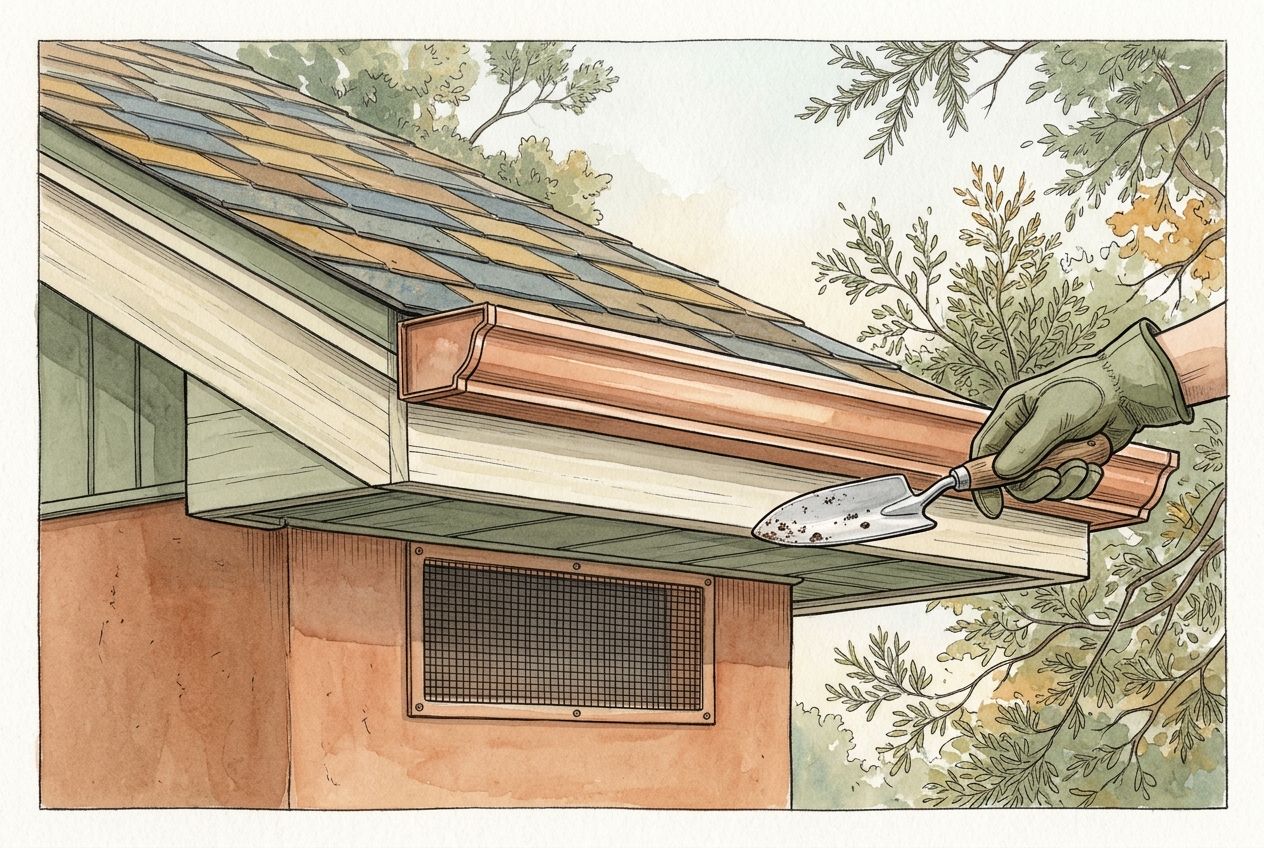
Watercolor close-up of a gloved hand clearing debris from a copper gutter with a trowel, above a fine-mesh vent screen
The most common Zone 0 failure is not a wrong plant. It is debris in a gutter or against a threshold, and an unscreened vent.

Clean roofs and gutters, cover vents with fine non-combustible mesh, keep firewood, trash cans and wooden furniture away from the walls, and break wooden fences with a metal or masonry section where they meet the house. A perfect landscape cannot save a house with open vents and a roof full of needles, and a hardened house with overgrown vegetation is also at risk. Do both.

Zone 1 / Zone A — Lean, Clean & Green

5 – 30 ft from structure

Goal: eliminate fuel ladders and prevent direct flames from reaching the house.

Strictly prohibited

  • Every species on the undesirable plant list below
  • Large woody shrubs or trees planted in continuous mass lines
  • Tree canopies overhanging roofs: prune branches back 5 feet from rooflines and 10 feet from chimneys
  • Woody understory plants beneath tree canopies, which create vertical fuel ladders

Allowed plant examples

  • Groundcovers: prostrate coyote brush (Baccharis pilularis ‘Pigeon Point’), sea lavender, manzanita groundcovers (Arctostaphylos cultivars)
  • Low shrubs and succulents: agave, aloe, dwarf bottlebrush (Callistemon ‘Little John’)
IdeaFrench lavender and similar aromatic, resinous shrubs (lavender, rosemary, sage) appear on some agencies’ approved lists and not on others. The most cautious reading keeps them out of Zones 0 and 1 and uses them, if at all, only in Zone 2, spaced, pruned and only if your agency approves them.

A succulent holds water in its leaves, and a soft-leaved shrub stays green and cool when it is irrigated. A parched plant is fuel. That is why local plans commonly call for an irrigated zone of low plants between the house and the thinned wildland.

Use drip irrigation, water the islands rather than the gaps or the wall, and remember that standard drip tubing melts: bury it or cover it, and keep it out of the first five feet.

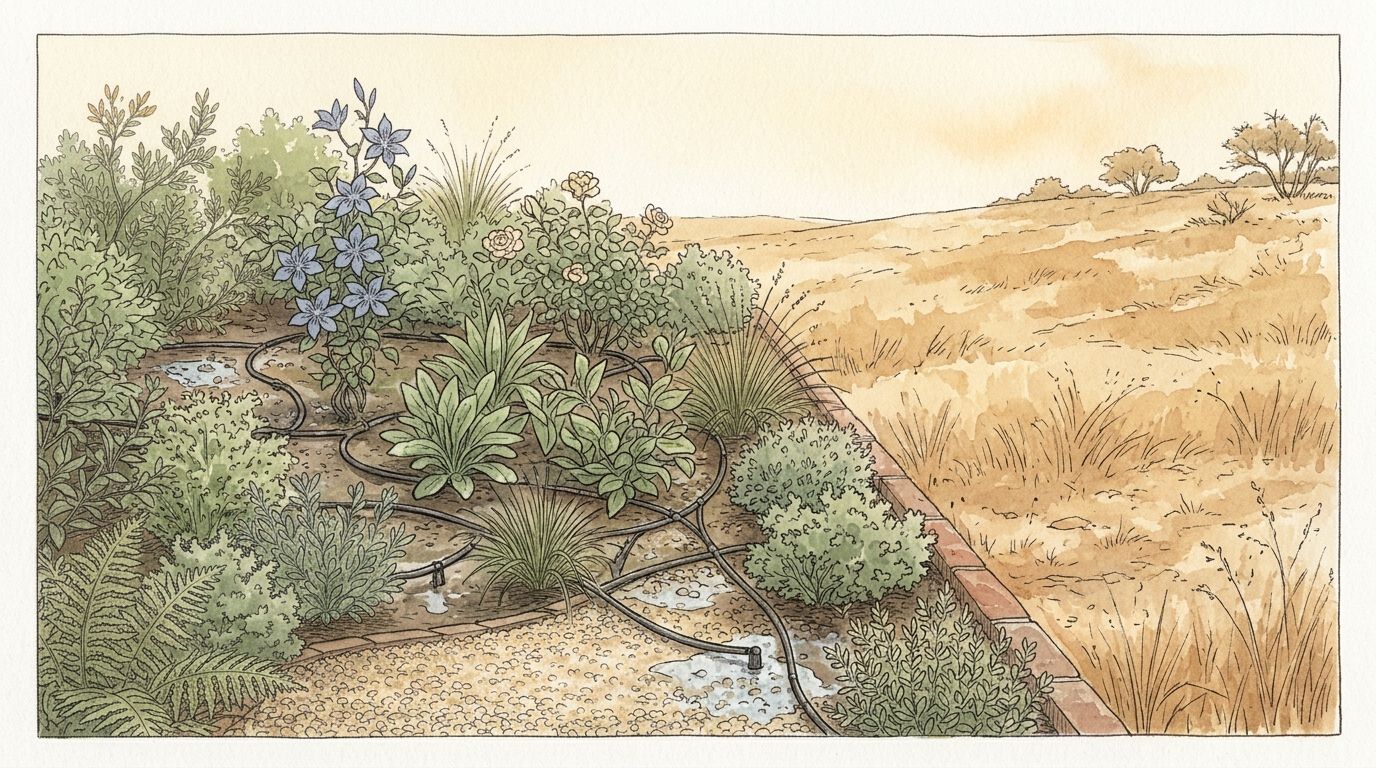
Watercolor of a green drip-irrigated planting bed beside a brick edge, with dry golden grass on the other side
Irrigated planting stays green and cool. The unirrigated grass beyond it cures and carries fire.

Zone 2 / Zone B — Fuel Reduction Zone

30 – 100 ft

Goal: disrupt the horizontal continuity of a wildfire.

Strictly prohibited

  • Unmaintained, dense native chaparral thickets: native brush cannot form continuous un-thinned stands
  • Untrimmed palm trees, such as Mexican fan palms or date palms with dead frond skirts
  • Un-mowed invasive grasses over 4 inches tall

Allowed plant examples

  • Spaced native and drought-tolerant trees and shrubs such as coast live oak (Quercus agrifolia), toyon (Heteromeles arbutifolia), and, only where your agency approves them, ceanothus and rockrose (Cistus spp.)
  • Provided canopy-to-canopy separation is maintained
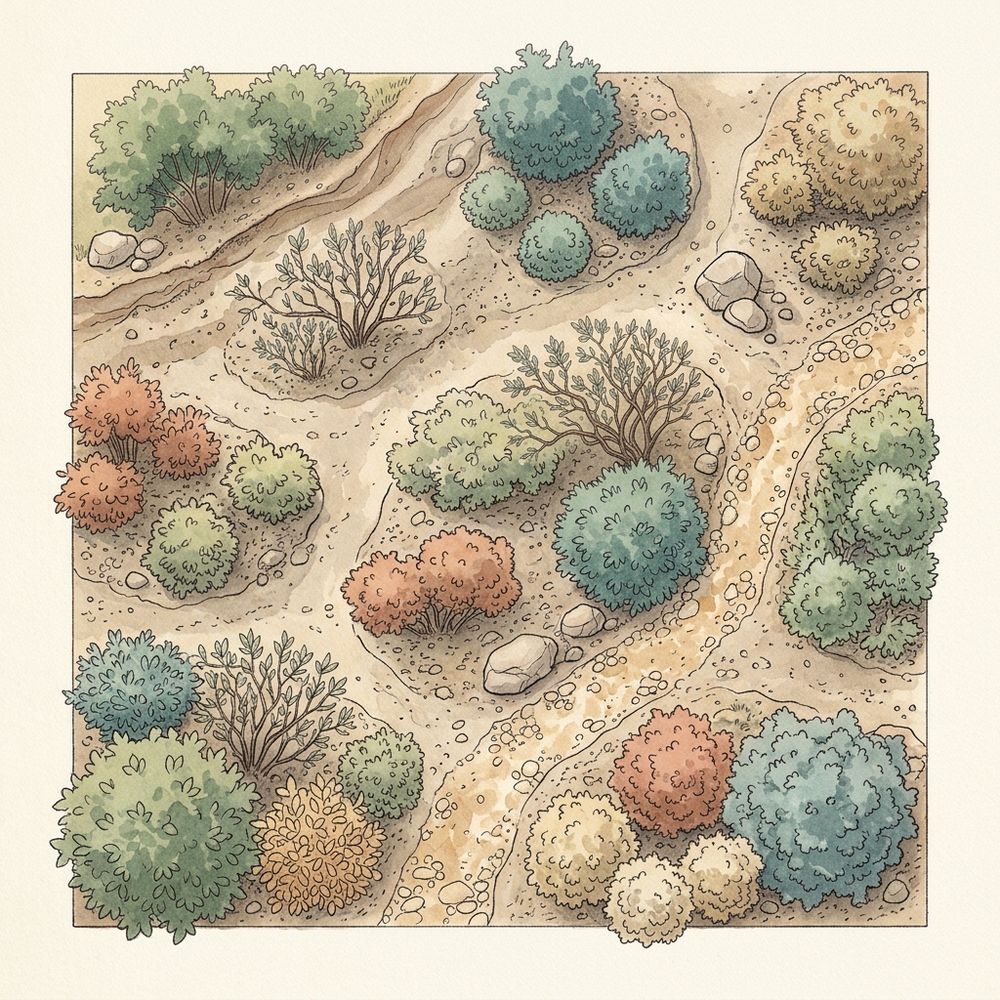
Watercolor plan view of shrubs grouped in separate islands with gaps of gravel and bare soil between them, and a winding path
The island approach: plants grouped in islands, separated by gaps of gravel, bare soil or short irrigated groundcover.

Fire needs a continuous path. Interrupt it sideways, with gaps between plant groups, and upward, with space between ground fuel, shrubs and tree canopies. Typical guidance for Zone 2 sets shrub spacing as a multiple of shrub height: about 2× on flat to mild ground (under 20% slope), 4× on moderate slopes (20–40%) and 6× on steep slopes (over 40%).

Space for the mature size of the plant, not for its size in a nursery pot, and keep annual grasses mown to about 4 inches before they cure.

Zone 3 / Zone C — Outer Buffer Zone

100 – 200 ft

Required in High Fire Severity Zones by some jurisdictions, such as LA County and Ventura County. Most others stop at Zone 2.

Strictly prohibited

  • Dead, dying or diseased trees and brush
  • Dense fuel ladders connecting ground brush to mature tree canopies
  • Heavy leaf litter accumulation and continuous thickets of native chaparral leading toward Zone 2

The Standard Prohibited Plant List.

Most California local fire authorities keep a master Undesirable (or Target) Plant List that is prohibited in fuel modification zones. These are the plants that appear most often.

Plant / treeWhy it is banned
Juniper (Juniperus spp.)Extremely flammable oils; retains hidden dead foliage.
Italian cypress (Cupressus sempervirens)Acts as a torch; collects dense interior dead needles.
Eucalyptus (Eucalyptus spp.)High volatile oils, peeling bark, heavy litter.
Pampas grass (Cortaderia selloana)Highly flammable dry plumes and dead center mass.
Broom (Spartium / Cytisus spp.)Highly invasive and combustible.
Chamise / red shank (Adenostoma spp.)Native brush with a high resin and fuel load.
Bamboo (various)High dry leaf volume; dense growth habit near structures.
Bougainvillea and climbing vinesCreate direct woody pathways for embers onto roofs.

Other plants that appear on many local lists include pines (Pinus spp.), acacia (Acacia spp.), fountain grass (Pennisetum setaceum), giant reed (Arundo donax), palms with dead frond skirts, and annual grasses and weeds such as wild oats, bromes and mustards.

AttentionAlways verify with your local Fire Protection District or City Fire Marshal. Jurisdictions such as LA County Fire, San Diego County and the Orange County Fire Authority enforce their own Plant Selection Guidelines with exact allowed and prohibited species lists for Fuel Modification Plans. Where an agency’s list differs from this page, the agency’s list governs. No plant is fireproof: even approved plants must be spaced, pruned, irrigated and cleared of dead wood.

A Fuel Modification Zone Is Also an Irrigated Landscape.

If your project is new construction, an ADU, a pool installation or a major renovation with an irrigated landscape, the irrigated band of your fuel modification plan counts toward the MWELO water budget. The same plants and irrigation that make the zone fire-resistant also decide whether it passes the water check. Many fire-resistant plants, succulents especially, are rated Low or Very Low in WUCOLS, so the two goals often work together.

Gravel Zone 0 areas, stone patios and a thinned, non-irrigated native outer zone generally do not count as landscape area, but confirm this with your agency. Use your fire agency’s plant list first, then WUCOLS for the water rating in your region, then the invasive plant inventory.

AttentionMWELO.com validates the water side only: hydrozones, plant factors, ETWU and MAWA. It does not evaluate flammability, spacing, clearance distances or your fire agency’s rules. A plant that passes the water budget is not therefore approved for a fuel modification zone. Both checks are needed.
Next step

Check the Water Side of Your Planting.

Group your irrigated plantings into hydrozones, check their WUCOLS ratings for your region and see whether your design fits its MWELO water budget. The tool also marks plants on the standard undesirable list while you search.

Open My Project → See How It Works

Educational use only; not legal or professional advice. Local fire agencies may require more than the state minimum. Not valid for Santa Monica projects.